Key Takeaways
- The first 48 hours are the hardest; contain the puppy to one room and start crate training immediately.
- GSD puppies bite relentlessly. Enforcing naps is the most effective way to stop an overtired 'land shark'.
- Socialization before 16 weeks is critical, but it means 'exposure' to the world, not forced interaction with every dog.
Nobody warns you adequately.
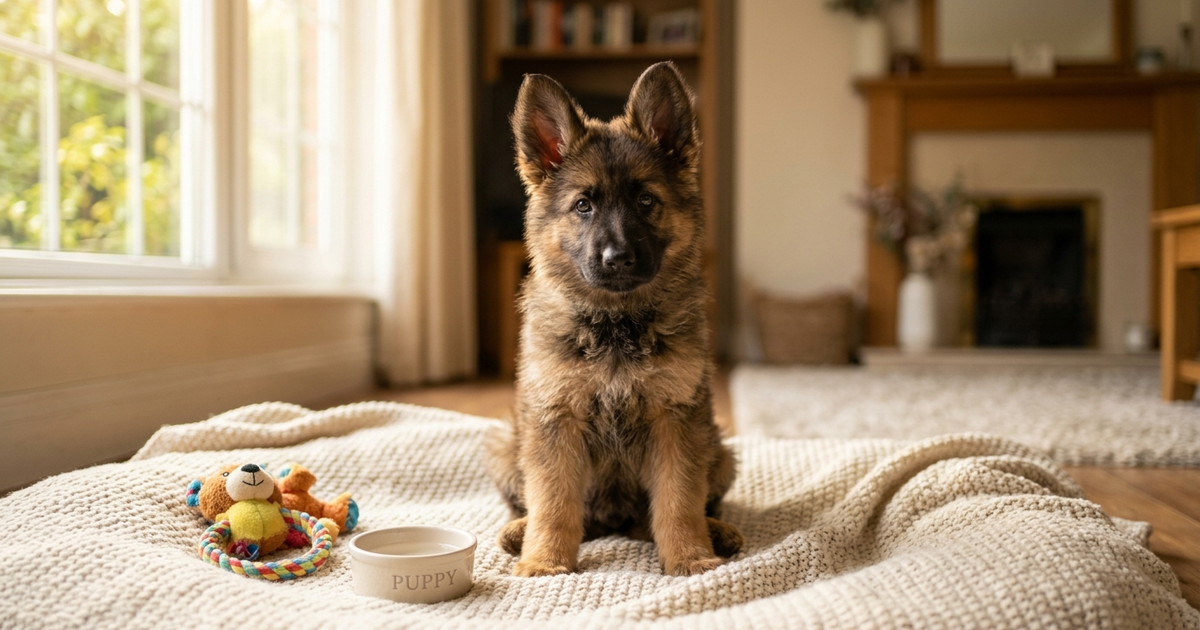
The books say “puppies require patience.” They don’t say you’ll spend the first 72 hours questioning every decision you’ve ever made, running on four hours of sleep, and wondering if you accidentally adopted a piranha with fur.
German Shepherd puppies are called “land sharks” by the community, and it’s accurate. They are mouthy, energetic, loud, and relentlessly demanding of your attention. They’re also, somehow, the most rewarding thing you’ll ever do.
This guide is the practical version many new owners wish they had before bringing a GSD puppy home. Not the sanitized version — the version that actually prepares you for the first eight weeks.
Week 1: Arrival and the Reality Check
The first 48–72 hours are genuinely hard, and you should know that before dismissing how you feel.
Your puppy has just been separated from its mother, littermates, and the only environment it’s ever known. It’s going to cry. It’s going to cry at 2am, 3am, and 4am. It may refuse to eat. It may have stomach upset from the transition. All of this is normal.
Your first 48-hour priorities:
- Contain the space — puppy-proof one room, not the whole house
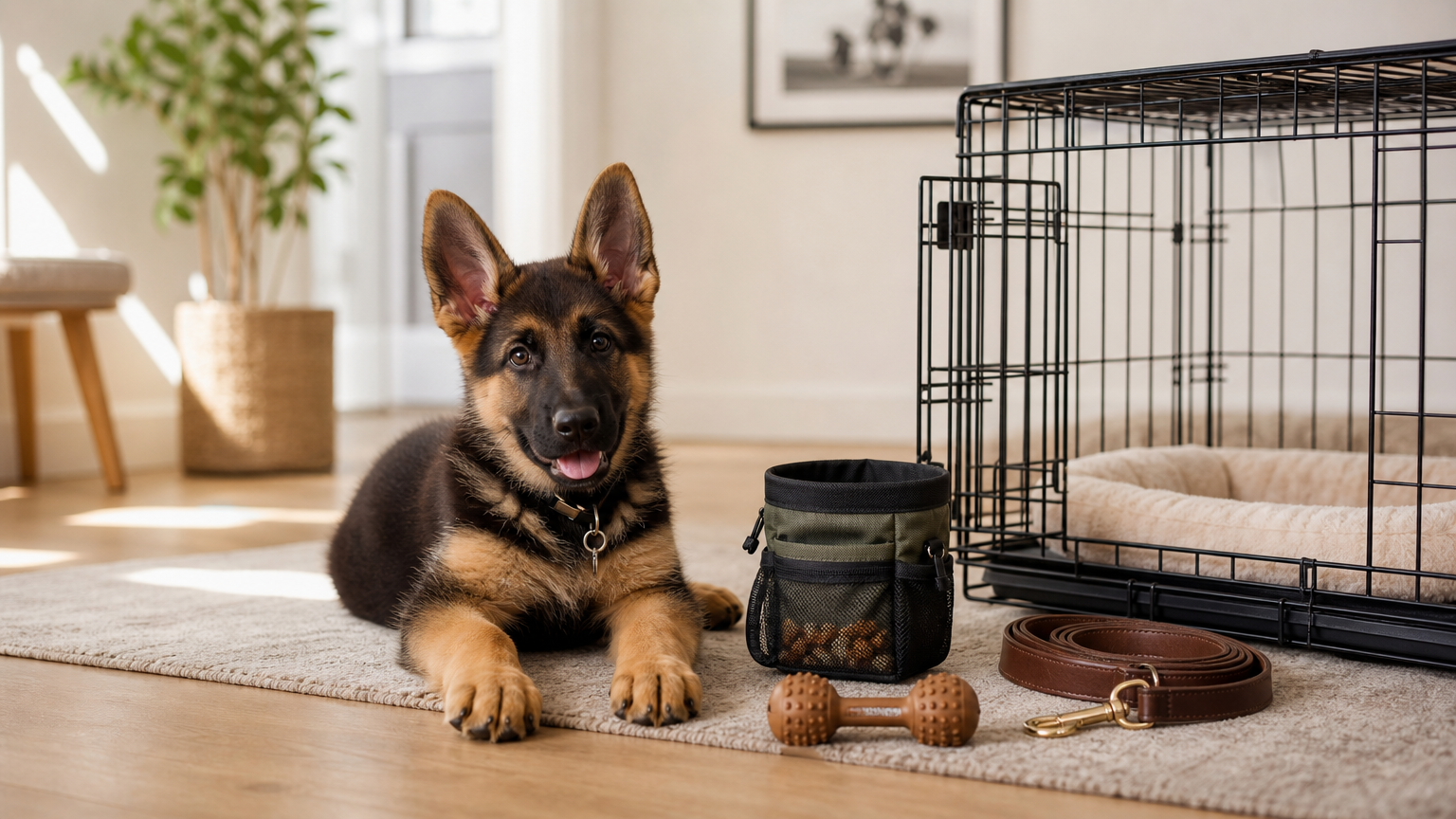
- Establish where the puppy sleeps (crate next to your bed is the community-recommended setup)
- Begin the crate introduction immediately, not after “a few days to settle”
- Start taking the puppy outside every 2 hours for potty breaks
🔍 Reddit Insight: “Puppy blues” is a term that appears constantly on r/germanshepherd and r/dogs in threads from new GSD owners. The phenomenon is real: many people feel overwhelming regret, exhaustion, and doubt in the first days or weeks. Experienced owners consistently respond with: “It passes. The 8-week-old that’s making your life impossible turns into the dog you can’t imagine living without. But you have to get through week one first.” Knowing this in advance doesn’t eliminate puppy blues — but it helps to know you’re not alone and you’re not making a mistake.
The Biting: Understanding (and Surviving) the Land Shark Phase
GSD puppies bite. Not because they’re aggressive — because biting is how puppies explore, play, and communicate. Your hands, feet, ankles, pant legs, and shoe laces will all become target practice.
Why puppies bite:
- Play communication — littermates bite each other constantly; you’re now a littermate
- Teething discomfort (begins around 3–4 months as adult teeth come in)
- Overstimulation and fatigue — overtired puppies bite hardest
- Genetic predisposition — remember, you’ve chosen a working or show line German Shepherd bred for high drive and mouthiness
What actually works:
-
Yelp and redirect: When bitten, make a sharp yelp and immediately redirect to a chew toy. Consistency is everything — every person in the household must respond the same way.
-
Enforce naps: This is the tip that changes everything for new GSD owners. An overtired puppy is a biting machine. If your puppy has been awake for 90+ minutes and is getting nippy, put them in their crate for a nap — not as punishment, just as regulation. The biting will often stop immediately post-nap.
-
Don’t roughhouse: Wrestling and tug with your hands directly teaches the puppy that hands are toys. Use toys as the interface for all rough play.
🔍 Reddit Insight: The enforced nap strategy is the most consistently recommended solution on r/germanshepherd for puppy biting issues. “Overtired puppy = biting puppy” appears in hundreds of comments with broad agreement. One r/germanshepherd power user described it as “the single most underrated puppy management tool that every GSD puppy owner needs.” New owners who try it report the biting drops noticeably within a week of consistent application.
Crate Training: Start immediately, not eventually
The crate is not a punishment. Trained correctly, it becomes your puppy’s safe space — the go-to location for sleep, calm time, and settling. Skipping crate training creates dogs that can’t self-regulate, which creates behavior problems that take months to unlearn.
Week 1 crate protocol:
- Introduce the crate with treats and meals — never force
- Cover with a blanket on three sides for den-like security
- Expect protest crying the first few nights — don’t immediately release, but don’t let distress escalate unchecked
- A heartbeat toy and an article of clothing with your scent can ease the transition
Crate schedule for weeks 1–8:
- Puppies can hold their bladder approximately 1 hour per month of age, plus one
- An 8-week-old puppy needs to go out every 2 hours during the day, once or twice overnight
- Nighttime accidents are not failure — they’re developmental reality
🔍 Reddit Insight: r/germanshepherd threads on crate training converge on one mistake: responding to crying by releasing the puppy. “You train them that crying opens the crate, and then the crying never stops,” one experienced owner explained. The correct response to protest crying: wait for a 3-second pause in the crying, then open the crate. You’re not rewarding silence — you’re rewarding a break in the vocalizing, which gradually lengthens as the puppy learns the crate is safe.
Potty Training: Consistency Wins, Punishment Loses
GSD puppies are smart, which means they learn fast — including learning that accidents in the house bring attention, even if that attention is negative.
Rules that work:
- Take outside every 2 hours, immediately after eating, and immediately after waking
- Always go to the same area — scent marking accelerates the association
- Praise immediately when they go outside — mark the moment (“yes!”) then praise
- Clean accidents with enzymatic cleaner — regular cleaners don’t eliminate the odor signals that prompt repeat accidents in the same spot
- No punishment for accidents — puppies can’t connect after-the-fact punishment with the behavior; you just create anxiety
Realistic timeline: Most GSD puppies are reliably house-trained by 4–5 months with consistent effort. Some take longer. Regression during teething (3–5 months) is common and temporary.
Socialization: The Window That Closes
Between roughly 3 and 16 weeks, puppies have a critical socialization window during which new experiences are absorbed without the fear response that develops later. What they’re exposed to during this window shapes their perception of the world for life.
German Shepherds are naturally wary and protective. Without adequate early socialization, this wariness can develop into excessive reactivity, fear-based barking, or stranger aggression.
Socialization priorities (before 16 weeks):
- Different types of people: children, men with hats, people in uniform, elderly people
- Different surfaces: hardwood floors, gravel, grass, grates, stairs
- Different sounds: vacuum cleaners, cars, crowds, other dogs
- Grooming tools: getting them used to daily brushing tools for double coats before they reach full size
- Gentle handling: ears, paws, mouth, tail — get them comfortable being touched everywhere before vet visits become a wrestling match
🔍 Reddit Insight: The most important nuance from r/germanshepherd socialization discussions: socialization doesn’t mean interaction. Many new GSD owners make the mistake of forcing their puppy to greet every dog and every person they encounter. This can backfire, creating an overwhelmed puppy that develops reactivity as a coping mechanism. The actual goal is exposure — the puppy sees, hears, and smells the world in a controlled, positive context. Let the puppy set the pace.
Training: Start Now, Keep it Short
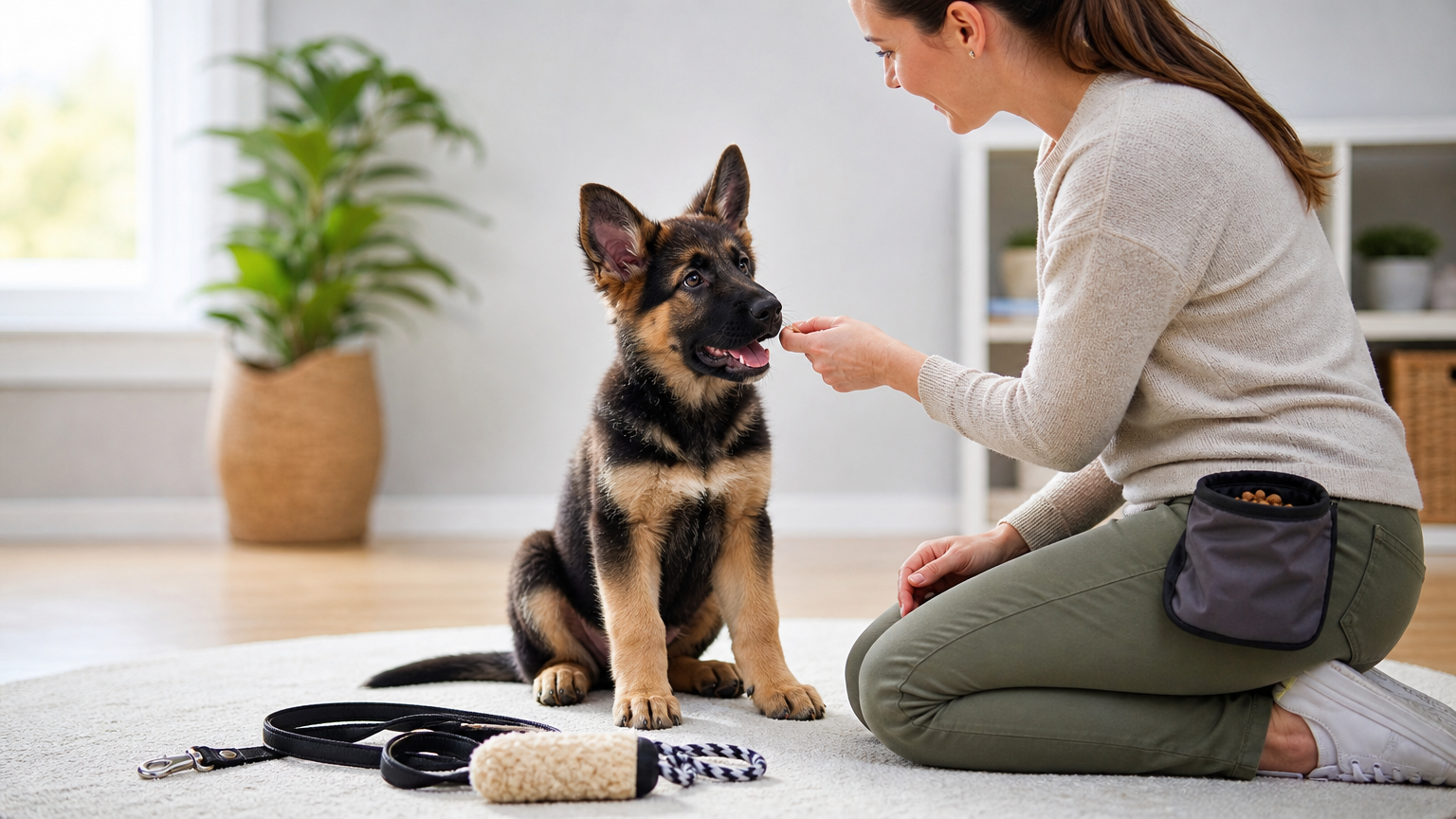
GSD puppies can learn basic commands at 8 weeks. The idea that you should “wait until they’re older” to start training wastes the period when their brain is most plastic.
Training principles for weeks 1–8:
- Sessions: 5–10 minutes maximum, 2–3 times per day
- Use food rewards — kibble from meals works; you don’t need to add extra calories
- First commands: sit, come, leave it, down
- Capture good behavior — when the puppy spontaneously sits, mark and reward immediately
Vet check on socialization: Once vaccinations are complete, puppy kindergarten classes provide structured socialization with other puppies in a controlled environment. This is worth the investment.
Managing Your Own Expectations
This is the section that doesn’t fit neatly elsewhere, but it matters.
GSD puppies are work. More than most breeds. They are intelligent enough to find every inconsistency in your rules. They have enough drive to make boredom dangerous. They bond intensely, which means separation anxiety is a real consideration if crate training is skipped.
🔍 Reddit Insight: The single most common message from GSD owners looking back on the puppy phase: “It gets so much better.” Every survey of established GSD owners on r/germanshepherd shows the same curve — peak difficulty weeks 8–16, genuine improvement by month 5–6 as the dog develops impulse control, dramatic improvement by year 1 as training takes hold and the dog’s personality matures. The work front-loaded in puppyhood compounds. The dog you build in the first year is the dog you live with for the next decade.
Week-by-Week Milestone Tracker
| Week | Milestones | Focus Area |
|---|---|---|
| 1 | Settles in crate overnight | Crate, potty, biting management |
| 2 | Reliably sits on command | Basic commands, socialization |
| 3 | 2-hour dry stretches inside | Potty consistency, loose leash introduction |
| 4 | Coming when called in yard | Come command, recall games |
| 5 | Puppy kindergarten ready (with shots) | Group socialization |
| 6 | Stays 10–15 seconds | Duration commands, impulse control |
| 7 | Walks on leash without constant pulling | Leash manners |
| 8 | Full potty training indoors | Consolidation of all skills |
Frequently Asked Questions
My GSD puppy isn’t eating — is that normal?
A day or two of reduced appetite during the transition home is common due to stress. Offer the same food the breeder used (ask before pickup) to avoid additional GI upset. If the puppy isn’t eating after 48 hours or shows other symptoms, consult your vet.
When can my GSD puppy go to the dog park?
After completing their vaccination series, typically around 16 weeks. Before that, stick to controlled socialization with dogs you know are vaccinated. The risk of parvovirus in uncontrolled environments is real during this window.
How much exercise does a GSD puppy need?
Less than you think. A general guideline is 5 minutes of structured exercise per month of age, twice daily. Over-exercising a puppy before growth plates close (typically 12–18 months) can cause joint damage. Mental stimulation through training and enrichment matters more than physical exercise in the early months.
Is it normal for my puppy to be scared of everything?
Some wariness is normal, especially in the first week. If fearfulness persists or worsens at 10+ weeks despite socialization, discuss with your breeder and vet. Some bloodlines are more sensitive, and early fear responses can sometimes signal a temperament concern worth addressing with a trainer.
Ready to find your perfect GSD match?
Take our 2-minute behavioral quiz. We'll match your lifestyle (and patience level) with the exact GSD bloodline and coat type you need — before you bring home a land shark.
Take the Matching Quiz →