Key Takeaways
- GSD puppy biting is normal breed behavior — not aggression — but it still needs to be addressed early because their bite pressure increases fast.
- The fix depends on *why* your puppy is biting: teething, overstimulation, demand behavior, or lack of bite inhibition each require different responses.
- The single most effective technique is a calm withdrawal of attention (not yelling, not holding their mouth shut, not alpha rolls) — repeated consistently for 2–3 weeks.
Your hands look like you lost a fight with a rosebush. Your ankles have tiny puncture marks. Your kids are starting to avoid the puppy. And somewhere in the back of your mind, a voice is whispering: is this normal, or did I get an aggressive dog?
Let me put that fear to rest right now: your German Shepherd puppy is not aggressive. Your German Shepherd puppy is being a German Shepherd puppy.
This breed was developed to use their mouth. Herding, apprehension work, carrying, gripping — it’s all oral. When your 10-week-old GSD latches onto your forearm like a tiny alligator, they’re not showing dominance. They’re doing exactly what their genetics are telling them to do. The problem isn’t that they bite. The problem is that nobody has taught them how to bite and when to stop.
That’s what this guide is for. Not generic “just redirect” advice. A breed-specific decision tree that helps you figure out why your puppy is biting right now and the exact response for each scenario.
Why German Shepherd Puppies Bite More (and Harder) Than Other Breeds
Before we fix the problem, you need to understand why GSDs are in a different category than, say, a Cavalier King Charles puppy who mouths gently during play.
The Breed Factor
German Shepherds were selectively bred for bite work. Whether your puppy comes from working lines or show lines, that genetic foundation is there. Working lines tend to have higher bite drive and more persistent mouthing. Show lines are often softer in the mouth but still significantly mouthier than most breeds.
This means:
- Your GSD puppy’s bite pressure at 12 weeks is already stronger than many adult small breeds
- Their desire to grab, hold, and tug is hardwired, not learned
- They won’t “grow out of it” without active training — they’ll just get bigger and stronger
The Teething Factor
GSD puppies start losing baby teeth around 12 weeks and have a full set of adult teeth by 6–7 months. During this window, their gums ache, and biting provides relief. This is real physical discomfort, not a behavior problem.
The Intelligence Factor
Smart dogs experiment. Your GSD puppy is constantly testing: what happens when I bite this? What about this? What if I bite harder? What if I bite and shake? Every reaction you give — including the wrong ones — teaches them something.
The Decision Tree: Diagnose Before You Correct
This is where most advice falls apart. “Redirect with a toy” is fine, but it only works for one type of biting. Here’s how to figure out which type you’re dealing with.
Type 1: Teething Bites
What it looks like: Your puppy chews on everything — furniture, shoes, your hands, the leash, the crate bars. The biting isn’t targeted at you specifically. They’re gnawing more than snapping. You might see them rubbing their face on carpet or drooling more than usual.
When it peaks: 3–5 months old.
The fix:
- Provide appropriate chew outlets: frozen Kongs, frozen wet washcloths, rubber teething toys
- When they chew on you, calmly replace your hand with a chew toy — no drama, no scolding
- Keep 2–3 chew options within arm’s reach at all times during this phase
- If they refuse the toy and come back to your hand, stand up and walk away for 10 seconds
What NOT to do: Don’t ice their gums with your fingers. You’re teaching them that your hand goes in their mouth.
Type 2: Play Biting (Overstimulation)
What it looks like: Your puppy is bouncy, excited, zooming around — and then they launch at your hands, arms, or ankles. The biting gets harder and faster the more you react. Their eyes might look a little wild. This often happens during play sessions, after meals, or in the evening “witching hour.”
When it peaks: 8 weeks – 6 months, especially during evening energy bursts.
The fix:
- The moment teeth touch skin, all fun stops. Stand up. Cross your arms. Turn your back. Say nothing.
- If your puppy jumps on your back or circles to bite again, leave the room entirely. Close a door or baby gate between you. Wait 10–15 seconds.
- Return calmly. If they bite again, repeat. You may need to do this 5–8 times in a single play session at first.
- After 3 days of consistency, most puppies start showing a visible pause before biting — that pause is the learning happening.
The critical rule: Everyone in the household must respond the same way. If one person withdraws attention and another person squeals and pushes the puppy away (which is a fun game for a GSD), the puppy learns that biting works on some people.
Type 3: Demand Biting
What it looks like: Your puppy bites you when they want something — food, attention, to go outside, to get on the couch. It’s not playful. It’s deliberate. They look at you, then bite. Sometimes they bark first, and when that doesn’t work, they escalate to biting.
When it starts: Usually around 4–5 months, when your puppy is smart enough to have learned that biting gets results.
The fix:
- Never give your puppy what they want immediately after they bite. Ever. Not even once.
- If they bite for attention: withdraw completely. Leave the room.
- If they bite because they want their food bowl: set the bowl down, and if they nip, pick it back up. Wait 30 seconds. Try again. They eat when they’re calm.
- Teach an alternative behavior: “sit” becomes the universal “please.” Sit gets food. Sit gets the door opened. Sit gets the leash on. Biting gets nothing.
Why this matters more for GSDs: This breed is persistent. A Labrador might try demand-biting twice and give up. A German Shepherd will try it 40 times with increasing creativity before accepting that it doesn’t work. Your patience has to outlast theirs.
Type 4: Bite Inhibition Deficit
What it looks like: Your puppy bites hard during play — hard enough to break skin regularly — even though they seem happy and relaxed. They never learned how much pressure is too much.
Common cause: Puppies separated from their litter before 7–8 weeks miss critical bite-inhibition lessons from siblings and their mother. Single-puppy litters also produce dogs with less bite inhibition.
The fix:
- This requires a graduated approach. You’re not trying to eliminate biting overnight — you’re teaching pressure control.
- Week 1–2: Only react to the hardest bites. When a bite actually hurts, withdraw attention. Let soft mouthing slide for now.
- Week 3–4: Lower your threshold. Now react to medium-pressure bites too.
- Week 5–6: Lower again. Now any teeth on skin = attention withdrawal.
- Week 7+: By now, most puppies are either mouthing very gently or not mouthing at all.
Why the graduated approach matters: If you punish all mouthing immediately, you skip the pressure-control lesson entirely. You end up with a dog who doesn’t mouth at all — until one day they’re startled or in pain, and their first bite is a full-force bite because they never learned to modulate.
The Techniques That Actually Work (Ranked)
These are the techniques most consistently recommended for this specific breed, ranked by practical usefulness.
1. Attention Withdrawal (Most Effective)
Teeth touch skin → you stand up, turn away, and go silent. If the puppy follows and bites again, leave the room for 10–15 seconds behind a baby gate or door.
Why it works for GSDs: German Shepherds are handler-focused. Your attention is the most valuable thing in their world. Removing it is the strongest consequence you can deliver — stronger than any correction.
Typical timeline: Noticeable improvement in 5–7 days with perfect consistency. Significant reduction in 2–3 weeks.
2. Structured Play With Rules
Use a tug toy (not your hands) for play. Teach “drop it” early. The game has a pattern: you initiate → puppy plays with the toy → if teeth touch skin, game ends → 15-second pause → game restarts.
This teaches your puppy that keeping their mouth on the toy = fun continues. Mouth on human = fun stops.
3. Reverse Timeouts
Instead of putting the puppy in a timeout (which can create negative crate associations), you leave. The puppy stays in the puppy-proofed room. You step out. This is the “reverse” — the human removes themselves rather than isolating the puppy.
This is especially useful if your puppy is in the middle of crate training and you don’t want to muddy the crate’s positive association.
4. Redirection to Appropriate Chews
Keep a toy in your pocket or nearby at all times. When your puppy starts mouthing, slide the toy into their mouth before teeth hit skin. This works best for teething-stage biting and less well for demand or overstimulation biting.
5. Capturing Calmness
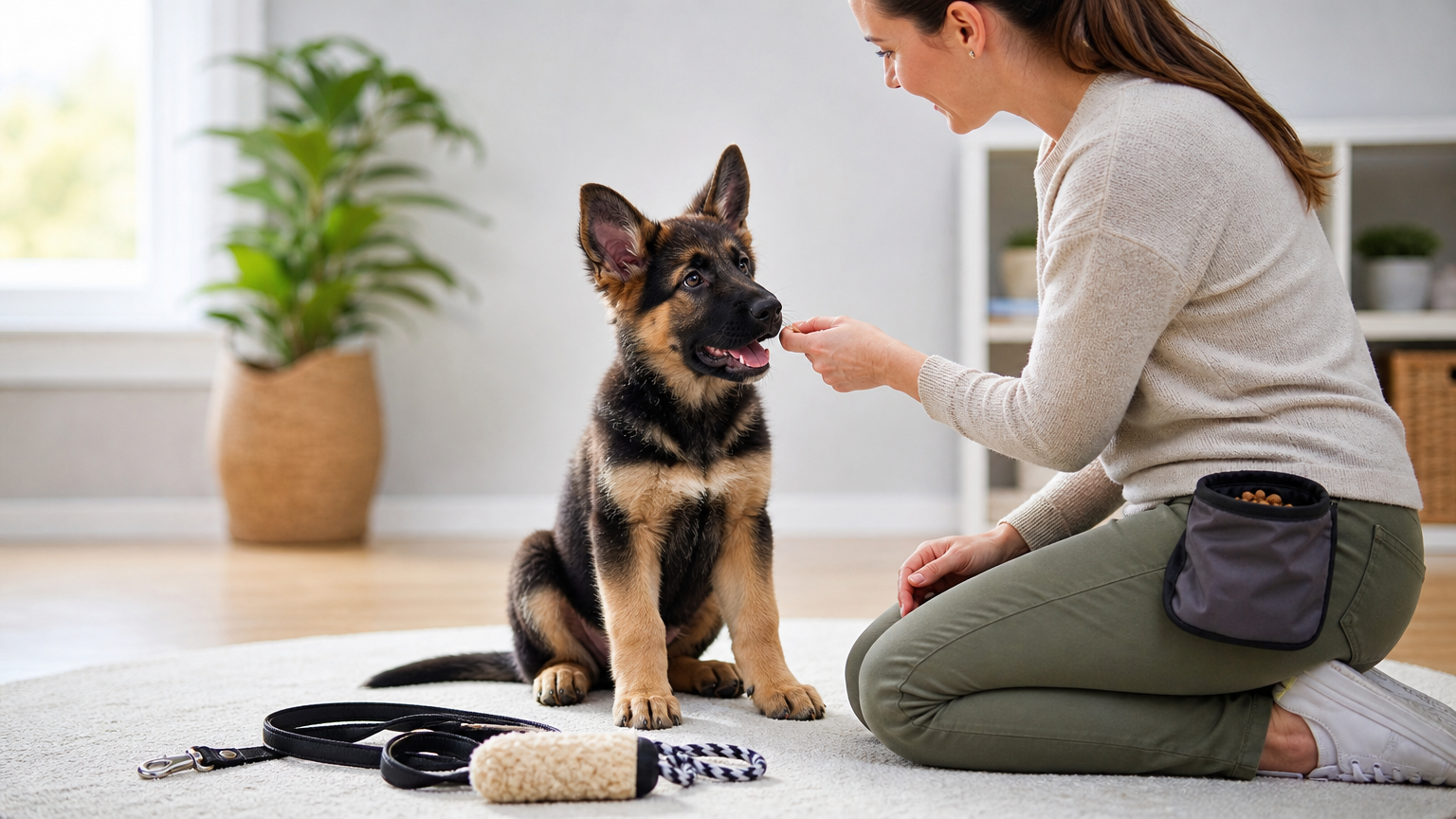
This is a long game, but it’s powerful. Every time your puppy is lying calmly near you and not biting, quietly drop a treat between their paws. Don’t say anything. Don’t pet them. Just reward the calm state.
Over time, your puppy learns that being still and quiet near you pays better than being a tiny land shark. This technique alone won’t stop biting, but combined with attention withdrawal, it accelerates results dramatically.
Tell us about your GSD's behavior and we'll show you the driving instinct behind it — plus what to do next. Takes 2 minutes.
What NOT to Do (and Why These Methods Backfire With GSDs)
The internet is full of biting advice that either doesn’t work with German Shepherds or actively makes things worse. Let me be specific.
Holding Their Mouth Shut
This teaches your puppy that hands near their face are threatening. You’ll create a dog who head-shies away from you — or worse, one who bites defensively when you reach for their muzzle. You also need to handle their mouth for tooth brushing, vet checks, and medication. Don’t poison that.
Alpha Rolls / Pinning Them Down
Pinning a German Shepherd puppy on their back does not teach submission. It teaches them that you’re unpredictable and physically threatening. GSDs are sensitive dogs under that tough exterior. This method creates fear-based reactivity, not respect.
Spraying Bitter Apple on Your Hands
This sometimes works for furniture chewing. It does nothing for play biting because the behavior isn’t about taste — it’s about interaction. Your puppy doesn’t bite you because your hands taste good.
Yelping Loudly
The classic advice: “Yelp like a hurt puppy and your dog will learn bite inhibition.” This works with some breeds. With many GSDs, a high-pitched yelp increases arousal. Your puppy gets more excited, not less. If you’ve tried yelping and your puppy bites harder or gets zoomies, stop immediately. It’s making things worse.
Pushing Them Away
When you push a German Shepherd puppy, they think you’re playing. Pushing is an invitation to engage harder. Your hands are now moving targets. This is why many owners feel like the biting gets worse when they try to physically stop it — because it does.
The Ankle-Biting Problem
Ankle and pant-leg biting deserves its own section because it’s the single most common complaint I hear from GSD puppy owners, and the cause is breed-specific.
Why GSDs Target Ankles
This is herding behavior. German Shepherds were bred to control the movement of sheep by nipping at their heels. When you walk past your puppy, you are a very slow, very large sheep. Your moving ankles trigger an instinct that’s been refined over a hundred years of selective breeding.
How to Stop It
Step 1: When your puppy grabs your ankle or pant leg, freeze completely. Stop walking. Become boring. Moving targets are fun. Stationary targets are not.
Step 2: Wait for your puppy to release. The moment they let go, mark it (“yes” or a clicker) and toss a treat away from you. This redirects their energy and rewards the release.
Step 3: Resume walking. If they grab again, freeze again. Repeat.
Step 4: After 3–5 days of this, start preemptively asking for a “sit” before you walk past your puppy. Sit = treat. Walking past without biting = treat. You’re building a new habit to replace the old one.
For kids: Teach children to “be a tree” — stand still, cross their arms, and look away. Running and screaming is the single biggest trigger for ankle-chasing in GSD puppies. If your children can’t reliably stand still (understandable for kids under 5), separate the puppy and children with a baby gate during high-energy periods.
Age-Based Expectations: A Realistic Timeline
One of the biggest sources of panic is not knowing what’s normal. Here’s what to expect:
8–12 Weeks
Constant mouthing. Everything goes in their mouth. Bite pressure is light but frequent. This is exploration, not aggression. Focus on gentle redirection and start the attention-withdrawal protocol.
12–16 Weeks
Bite pressure increases as jaw muscles develop. Teething begins. This is the critical bite-inhibition window — the best time to teach pressure control using the graduated method described above.
4–6 Months
Teething peaks. This is the worst period for most owners. Your puppy’s adult teeth are coming in, their gums hurt, and they’re also hitting adolescent energy levels. Biting may feel like it’s getting worse even if you’re doing everything right. Stay the course. This is temporary.
6–8 Months
Adult teeth are in. Teething pain subsides. If you’ve been consistent with attention withdrawal, you should see a dramatic reduction. If biting hasn’t improved at all by 7 months, it’s time to consult a certified trainer (CPDT-KA or equivalent) — not because something is wrong with your dog, but because you may need a professional eye on your timing and consistency.
8–12 Months
Most well-trained GSDs have stopped mouthing humans almost entirely by this point. Some adolescent GSDs will still grab a sleeve during high excitement. Continue the same protocol. It’s working — they just need a few more months of maturity.
When to Worry (and When to Get Help)
Normal puppy biting — even the intense GSD version — has specific characteristics. Here’s how to tell the difference between normal and concerning.
Normal Puppy Biting
- Loose, wiggly body during biting
- Biting decreases when excitement decreases
- Puppy can be redirected (even if it takes a few tries)
- Biting is worst during play and transitions
- Puppy shows other friendly behaviors: licking, tail wagging, play bows
Seek Professional Help If
- Your puppy’s body goes stiff before biting
- Biting is accompanied by sustained, low growling (not play-growling)
- Your puppy guards food, toys, or resting spots with biting
- Biting escalates when you try to disengage — they pursue and bite harder
- Your puppy bites without any apparent trigger (not during play, not during transitions)
- You see hard eye contact followed by a lunge
These patterns are rare in puppies under 6 months, but they do occur. If you’re seeing them, don’t wait. Find a certified professional dog trainer (CPDT-KA) or veterinary behaviorist — not a YouTube trainer, not a board-and-train facility that promises to “fix” your dog in two weeks.
The Household Consistency Contract
This is the part that makes or breaks everything, and it has nothing to do with your puppy.
Every person who interacts with your GSD puppy needs to follow the same rules. If you withdraw attention when the puppy bites but your partner rough-houses and lets the puppy gnaw on their hands, your puppy isn’t learning “don’t bite.” They’re learning “bite some people and not others” — which is actually a harder problem to fix later.
Have a family meeting. Agree on these non-negotiables:
- No one uses their hands as toys. Not wrestling, not “bitey face,” not letting the puppy chew on fingers because it’s cute at 10 weeks. It won’t be cute at 10 months.
- Everyone responds the same way to biting. Teeth on skin = stand up, turn away, disengage. No exceptions.
- Everyone carries a redirect toy. Keep tug toys in your pockets, on counters, by the door.
- No one punishes the puppy physically for biting. No smacking, no holding the mouth shut, no scruffing.
If you have kids, practice the “be a tree” response with them before the puppy is in the room. Make it a game. Kids who can freeze and cross their arms will get bitten dramatically less than kids who run and scream.
What’s Happening in Your Puppy’s Brain
Understanding the neuroscience isn’t required, but it helps you stay patient during the hard weeks.
When your GSD puppy bites and you react — yelp, push, yell — their brain gets a hit of arousal. Arousal isn’t good or bad; it’s activation. A highly aroused puppy can’t learn. They’re in reactive mode, not thinking mode.
When you withdraw attention calmly, arousal drops. In the quiet seconds that follow, your puppy’s prefrontal cortex (the learning, decision-making part) comes back online. That’s when the lesson lands: “Oh. The fun stopped when I used my teeth.”
This is why calm responses work and dramatic responses don’t. You’re not being passive. You’re being strategic. You’re creating the neurological conditions for learning to occur.
A Week-by-Week Starter Plan
If you want a concrete schedule, start here:
Week 1: Baseline
- Start the attention-withdrawal protocol for all biting
- Place chew toys in every room
- Hold a family consistency meeting
- Keep a simple tally of bites per day (just hash marks on your phone) so you can track progress
Week 2: Add Structure
- Begin structured tug sessions with rules: you start, teeth on skin ends the game
- Practice “sit” before meals, before leash goes on, before doors open
- Start capturing calmness with quiet treat drops
Week 3: Evaluate
- Check your tally. You should see a 30–50% reduction in bite frequency if everyone has been consistent.
- If no improvement, audit: is someone in the household responding differently? Is the puppy overtired (overtired puppies bite more — enforce nap times)?
Week 4: Refine
- Lower your bite-pressure threshold if using the graduated method
- Increase the duration of structured play sessions
- If improvement is on track, keep going. If not, consider a single session with a certified trainer for a timing check.
If you’re in the middle of navigating your first weeks with a new GSD puppy, know that biting is one piece of a larger puzzle. Getting the basics right — sleep schedule, crate routine, socialization — makes the biting problem easier because a well-rested, well-structured puppy bites less.
The Emotional Part Nobody Talks About
It is worth acknowledging something: GSD puppy biting can make you feel like a failure. Your hands hurt. Your kids are scared. Your friends’ puppies aren’t doing this. You start Googling “is my German Shepherd aggressive” at 2 AM.
You’re not failing. You picked a high-drive, intelligent, mouthy breed — and you’re dealing with the reality of that choice. The fact that you’re reading a 3,000-word article about bite inhibition instead of just smacking your puppy means you’re doing this right.
The biting phase can improve dramatically with consistent structure, appropriate outlets, and calm responses. Many GSD puppies who seem relentless at 4 months become reliable, gentle adults once bite inhibition and impulse control have had time to develop.
Your puppy will get there too. Be consistent. Be calm. Be patient for a few more weeks. The payoff is a dog who understands exactly how to use their mouth — and chooses not to.
Next Steps
If your puppy is still in the early weeks and you’re trying to get the full picture — sleep, crate training, socialization, and more — start with the GSD puppy survival guide. Biting is much easier to manage when the rest of your routine is solid.
If you’re already past the basics and trying to figure out your specific puppy’s behavior pattern, our handler assessment can help you identify what’s driving the behavior and give you a targeted first step.
Ready to find your perfect GSD match?
Take our 2-minute behavioral quiz. We'll match your lifestyle (and patience level) with the exact GSD bloodline and coat type you need — before you bring home a land shark.
Take the Matching Quiz →